Should I Start A Lifestyle Business in Midlife?
How corporate burnout and AI are creating a new generation of entrepreneurs who are redefining what success looks like.
I have a theory that we’re about to see a MASSIVE rise in lifestyle businesses, and ironically, AI might be one of the biggest reasons why.
For most of my career in venture capital, I was surrounded by people who wanted to build big companies. The ambition was to grow quickly, raise capital, hire teams, and eventually create something worth hundreds of millions or billions of dollars.
That was the entrepreneurial dream, and for a long time, it was the version of success I understood best.
But I think the next wave of entrepreneurship is going to look quite different.
I’m talking about people who have spent 15, 20, or 30 years building successful careers, developing expertise, and accumulating relationships, who are now looking at the rest of their working lives and wondering whether they really want to keep doing the same thing.
And for the first time, the alternative might be more accessible than they realize.
Corporate America has a problem
I don’t think we’ve fully appreciated how much COVID changed our relationship with work.
Millions of people experienced a different way of operating. They were still working and delivering results, but without some of the structures we’d been conditioned to believe were necessary. They discovered that productivity didn’t always require an office, and that having more control over their time made a meaningful difference in their lives.
Then came the return-to-office mandates, layoffs, pressure to do more with less, and now the relentless push to integrate AI into practically every function.
I’m hearing from more and more people who once loved their careers but now feel disconnected from the work itself. They’re spending their days managing systems, automating processes, and watching the creative and human parts of their jobs slowly disappear.
These aren’t people who have lost their ambition. They still want to work, create, solve problems, and make money. They’re just questioning whether the corporate environment is where they want to spend the next decade doing it.
The great irony of AI
The same technology that’s making corporate life increasingly unappealing is also making it dramatically easier to leave.
Think about what it took to start a business five years ago. You might have needed a designer, a developer, a marketer, and a handful of other specialists just to get an idea off the ground.
Today, someone with a laptop, a good idea, and a willingness to learn can accomplish an astonishing amount independently.
AI can help you research a market, develop your positioning, build a website, create marketing materials, automate operations, and test whether customers will actually pay for what you’re offering.
It doesn’t eliminate the hard parts of entrepreneurship. You still need to solve a real problem, find customers, and build something people value. But it dramatically reduces the cost and complexity of experimenting.
And that’s particularly interesting for someone who has spent the last 20 years developing expertise, building relationships, and learning an industry.
Consider a marketing executive who has spent decades helping companies grow. Rather than managing a department of 30 people, they could build a boutique practice serving a handful of clients they genuinely enjoy working with, using AI to handle much of the work that previously required a team.
The opportunity isn’t necessarily to invent something entirely new. It’s to take everything you’ve already learned and turn it into a business that works for the life you want now.
A different definition of ambition
This is where my venture capital background makes the shift particularly interesting.
We’ve spent decades celebrating companies that grow quickly, raise enormous amounts of money, and pursue increasingly ambitious valuations. Somewhere along the way, growth became the default measure of entrepreneurial success.
But what if you built a business that generated $300,000 a year in personal income, worked 25 hours a week, had very little overhead, and could spend several months traveling?
I’d argue that’s an extraordinary outcome.
And to be clear, a lifestyle business doesn’t mean you’re lazy, less ambitious, or uninterested in making serious money. You might want to make millions. You might build something incredibly valuable. The difference is that you’re being intentional about what you’re willing to sacrifice to get there.
You’re not automatically pursuing growth for growth’s sake, hiring people because that’s what successful companies do, or building an organization that eventually demands every waking hour of your attention.
You’re deciding what success looks like for you and building accordingly.
For someone who has already spent decades climbing the corporate ladder, that might mean a consulting practice with five clients, a portfolio of digital products, a small hospitality business, or a niche service company supported by AI.
These businesses aren’t necessarily easy to build, and they certainly aren’t guaranteed to succeed. But they don’t need to become enormous to be financially rewarding.
In fact, growing them beyond a certain point might defeat the entire purpose.
Don’t recreate the life you’re trying to leave
There’s one trap I think ambitious people need to be particularly careful about.
Leaving a corporate job that no longer fits, only to build a business that recreates all the things they were trying to escape.
When you’ve spent your entire career optimizing for achievement, it’s surprisingly easy to bring that same mentality into entrepreneurship. You get excited about an idea, start building, chase revenue, add complexity, and before you know it, you’ve created another demanding job with even less separation between work and life.
AI makes it easier to start building immediately, but that doesn’t mean you should.
I think the most important work actually happens before you launch anything.
What kind of life are you trying to create? How much money do you really want to make? What kind of work gives you energy? What are you uniquely good at? And what kind of business could bring those things together?
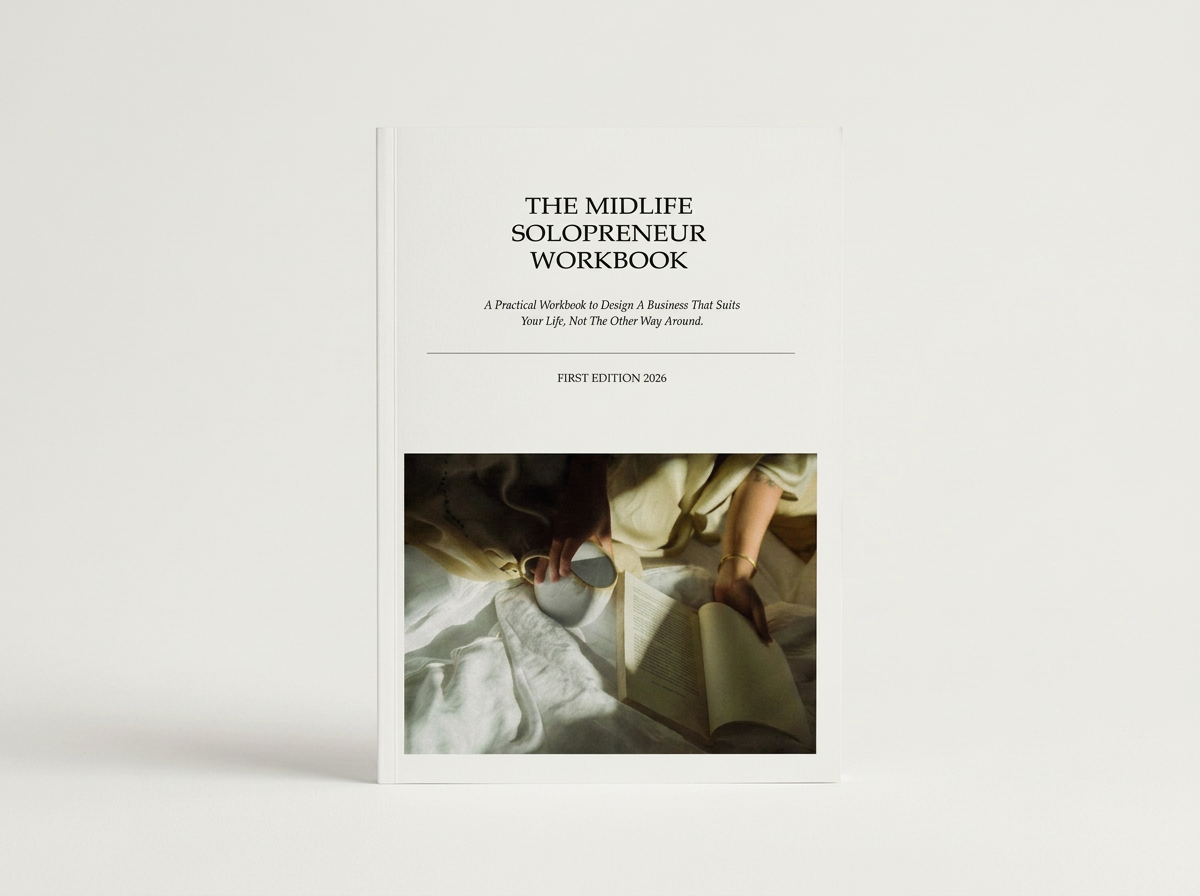
This is exactly why Richard and I created the Second Harvest Midlife Solopreneur Workbook.
It’s a practical starting point for people who have spent years building successful careers and are now considering something of their own. It helps you take stock of your experience, strengths, interests, financial goals, and lifestyle priorities before translating those insights into business ideas you can test.
Rather than jumping straight into execution because the tools are suddenly available, the workbook encourages you to be thoughtful about what you’re actually building and whether it fits the life you want.
Because the last thing you want is to become incredibly successful at building another life you don’t actually enjoy.
The next wave of entrepreneurship
I don’t think everyone is about to quit their corporate job and become an entrepreneur. Financial realities, personal responsibilities, and the challenges of running a business aren’t going away.
But I do think we’re entering a period where far more people will seriously consider it.
…and these are our people.
And the best news - you no longer have to make a dramatic leap to find out whether an idea has potential. You can build a simple version, test it with prospective customers, and see whether anyone is willing to pay for it before walking away from a paycheck.
So there is a pretty remarkable irony in all of this.
Corporate America is investing heavily in AI to make businesses more efficient, and in the process, it may be giving some of its most experienced employees the tools and motivation to leave.
Maybe the biggest entrepreneurial opportunity AI creates won’t be the next billion-dollar technology company.
Maybe it will be thousands of profitable, independent businesses built by people who have decided they want to spend the second half of their working lives differently.
And I think that’s a pretty exciting possibility.